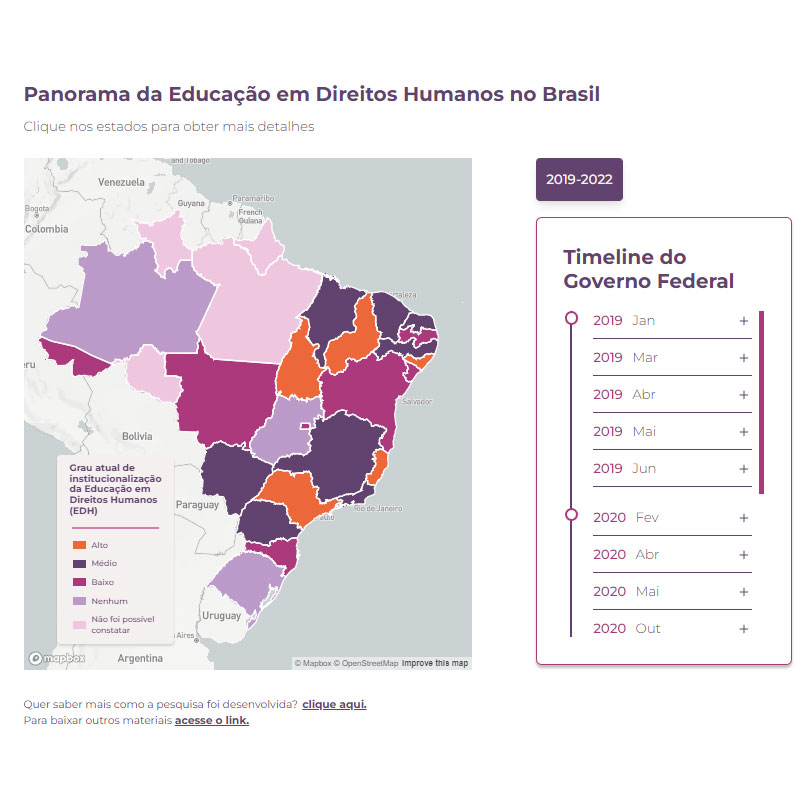
Overview of Human Rights Education in Brazil
We present an in-depth and inquisitive perspective to understand how the institutionalization of Human Rights Education (HRE) in Brazil has evolved since 2019, both at the federal level and across state governments. By looking at what has already taken place, we also seek to understand the future paths of the field. We recognize that Human Rights Education is more than a government department. It is a movement that sees in this field a real possibility for cultural change in our country, so that we may live with dignity.
This edition covers the first two years of the administration of Luiz Inácio Lula da Silva (2023–2024). In this publication, we update data from previous editions (2019–2020 and 2021–2022), revising the levels of institutionalization of Human Rights Education across Brazil’s federative units based on a new methodology. We also present the actions carried out at the federal level by the Ministry of Human Rights and Citizenship and the Ministry of Education, which are responsible for the field.
The research Overview of Human Rights Education: Institutions, Policies, and Actions was developed as an extension of the Overview of Human Rights Education: 2021–2022 Biennium.
For this study, we sought to deepen the data in order to reveal how Human Rights Education (HRE) is implemented in practice within public institutions. To achieve this, we conducted interviews with individuals responsible for HRE in each federative unit, resulting in an unprecedented national survey.
Overview of Human Rights Education in Brazil (2021–2022)
The 2021 edition was the first comprehensive study conducted by Instituto Aurora and highlighted the importance of documenting and disseminating, in an accessible manner, the institutional history of Human Rights Education in Brazil.
In this second edition, we present updated material that includes new information on actions carried out at the federal level, as well as a revised assessment of the levels of institutionalization of human rights education across all Brazilian states. The analysis covers the 2021–2022 biennium and follows the same methodology used in the previous edition.
Human rights education is not limited to the classroom. It is a movement—and one that is constantly in motion. As such, it can serve as a pathway toward building a freer, more equal, more supportive, and more dignified society.
The Overview of Human Rights Education in Brazil (2019–2020) presents the scenario during the first two years of the Bolsonaro administration.
Database on Human Rights Education in Brazil